
Jonas Salk and the Vaccine That Saved Millions
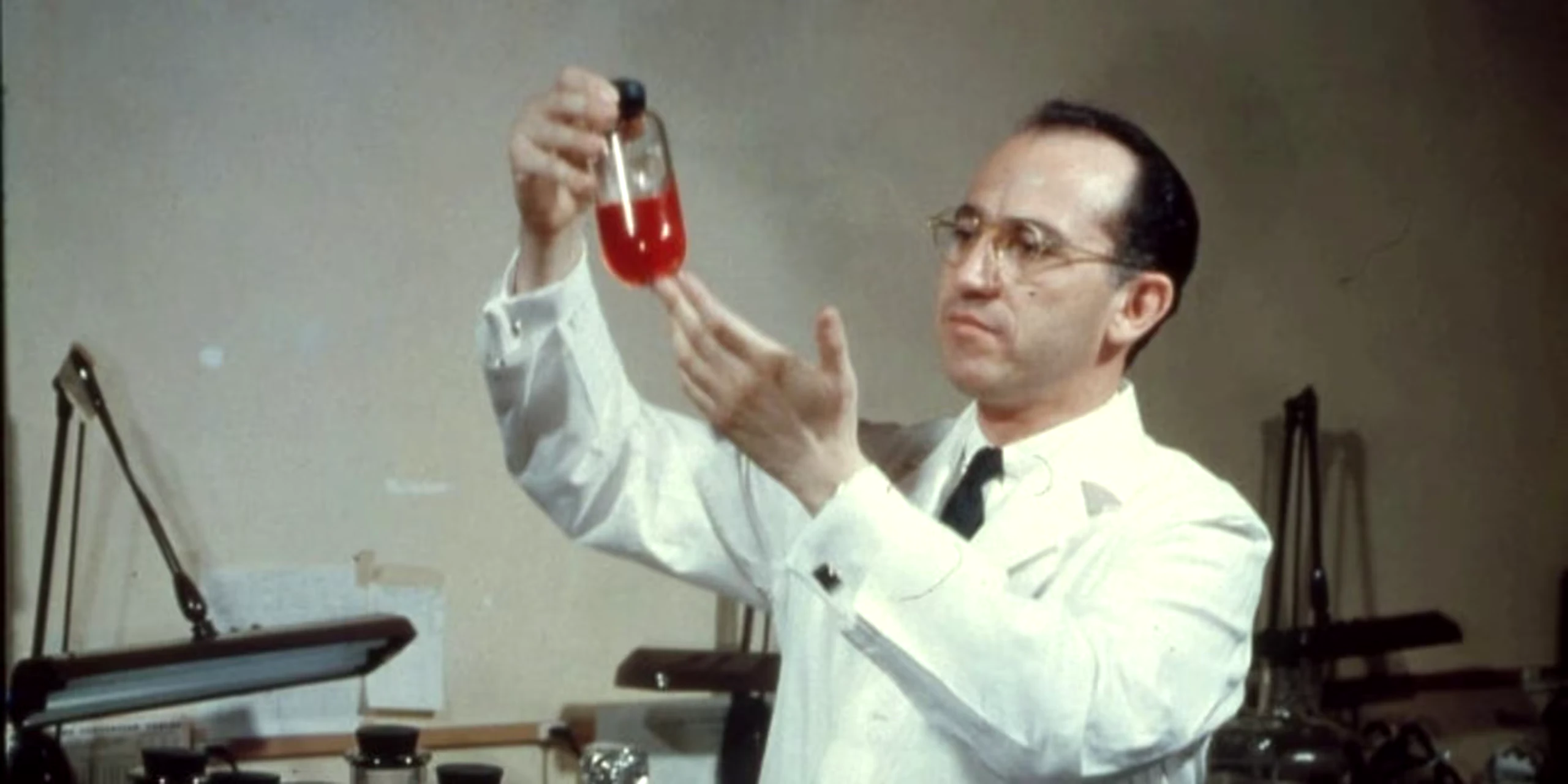
On April 12, 1955, a momentous announcement crackled across radios and television sets throughout America: the polio vaccine worked. Dr. Jonas Salk had done what many thought impossible—created a safe, effective vaccine against one of the most feared diseases of the 20th century. Church bells rang, factories observed moments of silence, and parents wept with relief. Children would no longer face summers of quarantine, paralysis, or death from a virus that struck without warning.
When a reporter asked Salk who owned the patent on the vaccine, he responded with words that would define his legacy: “Well, the people, I would say. There is no patent. Could you patent the sun?”
Table of Contents
Toggle
- The Disease That Terrorized America
- A Researcher With a Mission
- Racing Against a Rival
- The Largest Medical Experiment in History
- The Announcement That Changed Everything
- The Patent Question
- The Sabin Rivalry Continues
- Polio’s Near-Eradication
- A Scientist’s Later Years
- The Legacy of Giving It Away
- Sources and Further Reading
The Disease That Terrorized America
Before understanding Salk’s achievement, you need to understand the terror of polio. Today, most people in developed countries have never seen a case, but in the 1940s and 50s, polio was every parent’s nightmare. The poliovirus attacked the nervous system, and in severe cases, destroyed the motor neurons that controlled muscles. Victims—most of them children—could become paralyzed in hours.
The disease peaked in summer, when the virus spread most easily. Public swimming pools closed. Parents kept children home, afraid of crowds. Nobody knew exactly how it spread, which made prevention nearly impossible. Some children got mild flu-like symptoms and recovered. Others ended up in iron lungs—large metal cylinders that breathed for them when their chest muscles were paralyzed. Some died. About 35,000 Americans became disabled from polio every year during the epidemic’s peak.
President Franklin D. Roosevelt, paralyzed by polio in 1921, helped found the National Foundation for Infantile Paralysis (later known as the March of Dimes), which funded research and care for polio victims. The foundation’s fundraising campaigns made polio research one of the most well-funded medical efforts in history, supported by millions of ordinary Americans who donated their dimes and dollars to fight a disease that could strike any family.
A Researcher With a Mission
Jonas Salk wasn’t born into privilege or scientific aristocracy. Born in 1914 in New York City to Russian-Jewish immigrant parents, he was the first in his family to attend college. He studied medicine at New York University, graduated in 1939, and became interested in virology and immunology—fields that were still relatively new.
During World War II, Salk worked on developing an influenza vaccine for the military. This experience taught him about vaccine development and convinced him that killed-virus vaccines (using dead virus particles to trigger immunity) could work. Many scientists believed only live-virus vaccines were effective, but Salk thought differently.
In 1947, Salk became director of the Virus Research Lab at the University of Pittsburgh. When the National Foundation for Infantile Paralysis funded a massive project to classify different strains of poliovirus, Salk’s lab participated. But he wasn’t content just cataloging viruses—he wanted to prevent them.
Racing Against a Rival
Salk wasn’t the only scientist working on a polio vaccine. Dr. Albert Sabin, a more established researcher, was developing a live-virus vaccine. The two men represented different scientific philosophies and had little love for each other. Sabin thought Salk’s killed-virus approach was inadequate and wouldn’t provide lasting immunity. Their rivalry would shape vaccine development for decades.
But Salk pressed forward. Working long hours in his Pittsburgh lab, he and his team developed a vaccine using killed poliovirus strains. The virus was grown in monkey kidney cells, then chemically inactivated with formaldehyde so it couldn’t cause disease but would still trigger an immune response. It was painstaking, careful work—any mistake could create a vaccine that was either ineffective or, worse, still contained live virus.
By 1952, Salk was ready for human trials. In an era when medical ethics were less stringent than today, he did something that would be unthinkable now: he tested the vaccine on himself, his wife, and their three young sons. When none of them developed polio and all showed antibodies, he knew he was onto something.
The Largest Medical Experiment in History
In 1954, the National Foundation for Infantile Paralysis organized the largest public health experiment ever conducted. About 1.8 million children participated in what became known as the Salk vaccine field trials. Some received the vaccine, others received a placebo, and a third group served as an observed control. The trial was double-blind—neither the children nor the doctors administering shots knew who got which injection.
The logistics were staggering. Organizing vaccinations, tracking outcomes, and analyzing data for nearly two million children required unprecedented coordination. But America was desperate for a solution, and parents volunteered their children, hoping the vaccine would work while fearing their child might be in the placebo group.
Throughout 1954, researchers collected data while America waited anxiously. Would the vaccine work? Was it safe? The pressure on Salk was immense. If the vaccine failed—or worse, if it harmed children—it would be a catastrophic setback for polio research and his career.
The Announcement That Changed Everything
On April 12, 1955, Dr. Thomas Francis Jr., Salk’s former mentor who led the data analysis, announced the results at a press conference at the University of Michigan. The vaccine was safe and 80-90% effective against the most severe forms of polio. The announcement was broadcast live on television and radio to millions of anxious Americans.
The reaction was euphoric. Salk became an instant national hero, his face on magazine covers, his name known in every household. Parents rushed to get their children vaccinated. The March of Dimes mobilized to produce and distribute millions of doses. Within two years, polio cases in the United States dropped by 85-90%.
But the celebration was briefly interrupted by disaster. In April 1955, some vaccine produced by Cutter Laboratories in California wasn’t properly inactivated—it still contained live virus. About 200,000 children received these contaminated doses. Over 200 children developed polio from the vaccine, ten died, and many more were paralyzed. The “Cutter incident” was a tragedy that led to stricter vaccine manufacturing and safety regulations, ultimately making the vaccine production process safer.
The Patent Question
When Salk was asked who owned the patent to his vaccine, his response—”Could you patent the sun?”—became legendary. But the reality was more complicated. Salk’s employer, the University of Pittsburgh, explored patenting the vaccine but concluded it wasn’t novel enough to patent (a decision historians debate). Still, Salk’s philosophy was clear: the vaccine should be freely available.
By not patenting the vaccine, Salk potentially gave up billions of dollars in royalties. The vaccine generated enormous wealth for pharmaceutical companies that produced it, but Salk himself made no money from his discovery. He believed that making the vaccine affordable and accessible was more important than personal profit.
This decision stood in stark contrast to how pharmaceutical companies typically operated—and still operate today. It raised important questions about medical research, public good, and whether life-saving treatments should be profit-driven. Salk’s example inspired some researchers but wasn’t widely imitated. The debate over vaccine patents and pricing continues today, especially visible during the COVID-19 pandemic.
The Sabin Rivalry Continues
Despite Salk’s success, Albert Sabin’s live-virus vaccine eventually became more widely used globally. Approved in the 1960s, Sabin’s vaccine could be administered orally (rather than by injection), was cheaper to produce, and provided longer-lasting immunity. The live virus in Sabin’s vaccine could also spread to unvaccinated people, creating a “herd immunity” effect.
However, Sabin’s vaccine had a rare but serious risk: it could mutate and cause vaccine-derived polio in a tiny percentage of cases. Salk’s killed-virus vaccine had no such risk. Today, the United States uses Salk’s approach (in an improved form), while many developing countries used Sabin’s vaccine until recently because of its lower cost and easier administration.
The rivalry between Salk and Sabin persisted for decades, with each man defending his approach and dismissing the other’s. It was a reminder that even in life-saving medical research, egos and competition play a role. Both vaccines contributed to controlling polio, but neither man could fully appreciate the other’s contribution.
Polio’s Near-Eradication
Thanks to vaccination efforts using both Salk’s and Sabin’s vaccines, polio has been nearly eradicated worldwide. In 1988, when the Global Polio Eradication Initiative began, polio paralyzed about 350,000 people per year in 125 countries. By 2023, wild poliovirus remained endemic in only two countries: Pakistan and Afghanistan. The Americas were declared polio-free in 1994, followed by other regions.
This achievement—preventing a disease that terrorized the world—is largely the result of Salk’s initial breakthrough and the global vaccination campaigns that followed. Children today don’t fear summer, don’t know what an iron lung is, and have never seen a classmate paralyzed by polio. This absence of suffering is Salk’s legacy.
A Scientist’s Later Years
After his polio vaccine success, Salk continued researching, focusing later on developing an HIV vaccine (he was unsuccessful). In 1963, he founded the Salk Institute for Biological Studies in La Jolla, California, a prestigious research center that attracted top scientists. He wanted to create an environment where science, philosophy, and art intersected—a place where great minds could tackle humanity’s biggest challenges.
Salk died in 1995 at age 80, having lived to see polio nearly eliminated in much of the world. He received numerous awards but never won a Nobel Prize—a controversial omission that some attribute to his killed-virus vaccine being seen as less innovative than other approaches, and others to politics within the scientific community.
The Legacy of Giving It Away
Jonas Salk’s decision not to patent his vaccine remains one of the most striking examples of prioritizing public health over personal profit. It’s estimated that if he had patented it, the royalties would have been worth $7 billion or more. Instead, he chose to give it to the world.
This choice raises important questions we’re still grappling with today: Who should profit from medical discoveries? Should life-saving treatments be available regardless of ability to pay? What responsibility do scientists have beyond their research? Salk believed scientists had an obligation to humanity, not just to their careers or bank accounts.
His approach wasn’t perfect—it didn’t solve the structural problems in pharmaceutical development and pricing. But it demonstrated that another path was possible, that researchers could be motivated by saving lives rather than accumulating wealth, and that the public good could take precedence over private profit.
The polio vaccine’s success also vindicated the March of Dimes funding model: millions of ordinary people contributing small amounts to fund research that benefited everyone. It showed that public investment in science could yield enormous returns in health and wellbeing, a lesson that guided government research funding for decades.
Jonas Salk turned down billions of dollars because he believed a life-saving vaccine shouldn’t be owned—it should be shared. And in doing so, he didn’t just help eliminate a terrifying disease. He reminded the world that science, at its best, is a gift we give each other, not a product we sell to the highest bidder. His answer to that reporter’s question—”Could you patent the sun?”—captured a philosophy that saved millions of lives and continues to inspire researchers who believe medicine is a human right, not a luxury good.
Sources and Further Reading
- “Jonas Salk: A Life” by Charlotte DeCroes Jacobs
- The College of Physicians of Philadelphia’s History of Vaccines project
- March of Dimes Archives on polio vaccine development
- “Polio: An American Story” by David M. Oshinsky
- Centers for Disease Control and Prevention polio eradication documentation