
Martin Luther King Jr. and the Dream of Equality – How one man’s powerful words and peaceful protests helped change America
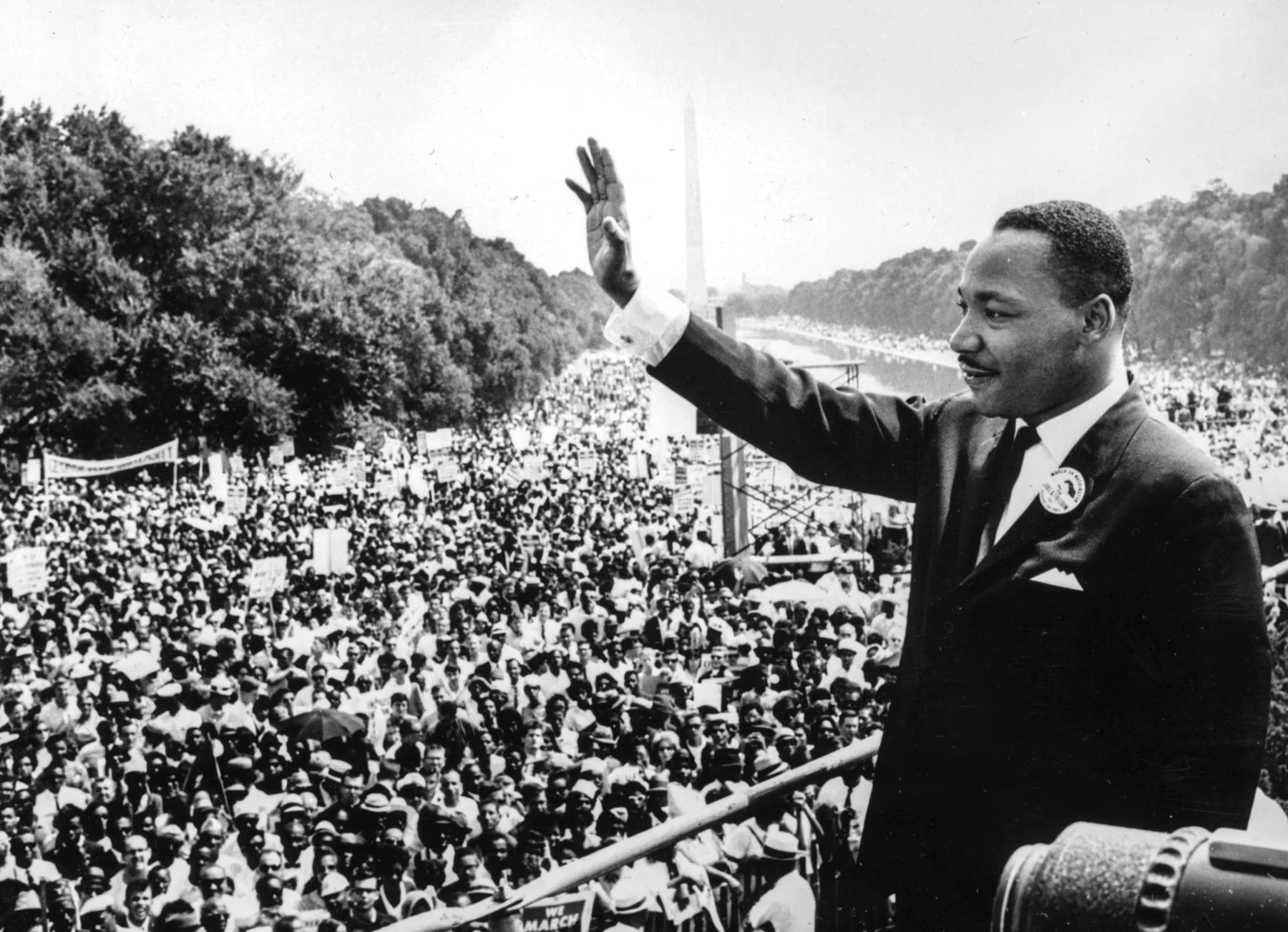

Everyone knows that speech. But here’s a twist you didn’t expect: the “I Have a Dream” moment— that part that’s carved into statues, replayed in classrooms, and quoted by presidents — wasn’t planned at all. It wasn’t in the script. It wasn’t in the drafts — not for this script anyway, it was cut.
But then gospel legend Mahalia Jackson called out from behind him, “Tell ‘em about the dream, Martin!” and everything flipped.
King paused, shifted his weight, slid the typed pages aside, and started speaking straight from memory.
No rehearsal.
No teleprompter.
Just instinct.
And the funny thing?
That improvised moment turned into one of the most important speeches in American history.
Because King wasn’t just a leader — he was a storyteller who understood how a single well-chosen phrase could move people more than a stack of policy papers.
Table of Contents
Toggle
- The Speech That Almost Stayed Ordinary
- How King Used Words Like Tools
- Three Speeches That Don’t Get Enough Credit1. “Give Us The Ballot” — 19572. “Letter from Birmingham Jail” — 19633. “I’ve Been to the Mountaintop — 1968
- Why His Words Still Show Up Everywhere
- The Legacy of an Unplanned Moment
The Speech That Almost Stayed Ordinary
The March on Washington in 1963 wasn’t exactly what you’d call calm. It was crowded. Loud. People had traveled for hours, sometimes days, to get there. Over a quarter of a million were in attendance, and over 3,000 members of the press covered the historical march.
Everyone expected something big from King — something moment-defining.
But the first part of his prepared speech?
It was…. Fine. Solid. Important. But it was missing something. It wasn’t what you’d call “electric”.
King talked about laws and promises, broken agreements, segregation, and discrimination. It was what you’d call a “responsible” version of the speech. It was safe.
However, Mahalia Jackson, listening behind him, knew it wasn’t enough.
She’d heard King in packed churches where he used the “dream” theme long before the world heard it on TV. She knew the fire he carried when he dropped the script and started preaching from the heart.
So she shouted.
He switched lanes.
And just like that, history changed direction. In a mere 16 minutes.
When King began the dream sequence, you can actually hear the crowd’s reaction in the recordings — cheering, clapping, shouting back. The energy in the crowd snapped awake, and you could almost feel the temperature change.
Isn’t it wild to think that the most iconic part of the speech — the part etched into stone — existed only because someone in the moment trusted her gut?
How King Used Words Like Tools
Here’s the thing: King didn’t speak the way other politicians did. He spoke the way people needed to hear.
Short, vivid phrases. Images you could picture instantly. Lines that got stuck in your head like a song.
He didn’t say “America failed to uphold equal rights.”
He said the country had given Black citizens a “bad check marked insufficient funds.”
He did not describe racism as a bureaucratic issue.
He described it as “the quicksand of racial injustice,” which makes you physically feel the sinking.
This is why his speeches spread so quickly — because everyone understood them.
Even the FBI’s surveillance memos accidentally prove this. Agents wrote pages about newspapers reprinting King’s lines, radio stations rereading his words, and crowds repeating them at rallies. They were tracking his influence without meaning to.
King didn’t just speak to inspire.
He spoke to clarify.
To translate complicated issues into something a bus driver, a teenager, a factory worker, or a schoolteacher could understand without needing a dictionary.
And he did it all while being watched, criticized, and threatened almost daily.
Three Speeches That Don’t Get Enough Credit
Everyone knows the “dream” speech, but plenty of King’s most powerful ideas came out long before — and long after — that day in Washington.
1. “Give Us The Ballot” — 1957
This speech came before King became a worldwide figure.
Before the marches.
Before the spotlight.
He stood in front of a crowd and argued that voting rights were the key to everything else — representation, fairness, policy change. He said that if Black Americans were simply allowed to vote freely, the country would “transform the bleak and desolate valleys of injustice.”
It wasn’t flashy, but it was strategic.
And it planted the seeds for the Voting Rights Act eight years later.
2. “Letter from Birmingham Jail” — 1963
Not technically a speech, but it moves like one.
King wrote it while sitting in a tiny jail cell, scribbling sentences on scraps of newspaper and the margins of legal papers. Police had arrested him during nonviolent protests, and local leaders kept telling him he was pushing too hard and too fast.
His reply?
Justice doesn’t work on a schedule.
The letter is still famous for calling out the “white moderate” — the comfortable bystander who doesn’t oppose change but doesn’t support it either. It’s blunt, honest, and painfully relevant all these decades later.
3. “I’ve Been to the Mountaintop — 1968
This one hits differently when you know the timing.
King delivered it the night before he was assassinated. He was speaking to Memphis sanitation workers striking for fair pay and safer conditions. He talked about the danger he faced — the threats, the attacks, and then said something that made the entire room go silent:
“I may not get there with you, but I want you to know tonight that we, as a people, will get to the Promised Land.”
It was hopeful, fearless, and strangely peaceful.
And it was his final public message.
Why His Words Still Show Up Everywhere
Scroll through social media at any moment of national tension, and you’ll find King’s words everywhere — not because they’re trendy but because they still work.
People use them on signs, in captions, in conversations, in school projects, in political speeches, and in everyday chats about fairness.
It’s not because he was perfect.
It’s because he was clear.
He didn’t dress them up.
He didn’t water them down. He didn’t hide behind jargon or complicated theories.
He painted pictures.
He told stories.
He made justice feel like something you could see, not just something you could debate.
And that’s why his words travel so well from decade to decade. They weren’t written for one moment. They were written for anyone willing to imagine something better.
The Legacy of an Unplanned Moment
The funniest thing about history is how often the biggest moments aren’t planned. King didn’t plan to give his speech the “dream” section, and Jackson didn’t rehearse it — she simply felt the moment and called out. The crowd didn’t plan to witness one of the most quoted speeches on the planet.
But that unscripted moment changed everything.
King believed that hope wasn’t abstract — it was actionable. You could speak it, build it, and march it forward. And people responded because they felt seen, not lectured.
Maybe that’s the real story here.
Not that MLK had a dream, but that he trusted it enough to say it out loud when the world needed to hear it the most.