
Black Wednesday 1992: How George Soros Broke the Bank of England

Today in the US, there are 902 billionaires with control over 6 trillion dollars, but if we take it back in time, from 2025 to 1992, there was one man who made a billion in a single day.
That’s right, one billion UK pounds in profit (around $1.5 billion in USD) in a mere twenty-four hours. And he didn’t build a thing.
Unlike Jeff Bezos, who created Amazon and catapulted himself to billionaire status, this man bet that the British Government was lying to itself.
And he was right.
That one bet sent shockwaves through Europe’s economy and humiliated the Bank of England.
That man was George Soros, a quiet hedge fund manager with a talent for spotting cracks. And on September 16th, 1992, with Britain clinging to a failing currency system, Soros walked away as the man who broke the Bank of England.
Table of Contents
Toggle
- The Setup – Britain’s Big Gamble
- The Man Who Saw It Coming
- Black Wednesday
- The Fallout
- Soro’s reputation – Legend and Lightning Rod
- The Lesson That Won’t Go Away
The Setup – Britain’s Big Gamble
Taking things back to two years earlier, Britain had joined the European Exchange Rate Mechanism (ERM) — a system designed to stabilise European currencies by keeping them within a tight trading band against the German Deutsche Mark.
The idea sounded smart: prove Britain could match Europe’s economic discipline and bring inflation down. But it came at the worst possible time.
For ordinary households, these policy choices hit hard. Mortgage payments doubled in a few years, small businesses folded under loan costs, and consumer spending shrank fast. Confidence in Westminster’s economic judgement was already thin, and that growing frustration would soon meet a far more brutal reckoning on the currency markets.
The country was in recession. Unemployment was rising, and homeowners were crushed by high mortgage rates. Yet staying inside the ERM meant keeping those rates high — because Germany, fresh from reunification, was battling inflation and raising its own.
Britain had effectively pegged its fragile economy to Europe’s strongest currency. By 1992, traders knew the pound was overvalued.
Prime ministers John Major and Chancellor Norman Lamont insisted they’d defend it “at all costs”
Markets heard those words and decided to test “what all costs” really meant.
The Man Who Saw It Coming
Enter George Soros.
Soros has built his career on spotting illusion. A Hungarian-born holocaust survivor who escaped to London, he studied philosophy before turning to finance — a man who understood how fragile systems could look solid until the moment they cracked.
Through his Quantum Fund, Soros began quietly short-selling the pound. He borrowed sterling, sold it for marks and dollars, and waited for gravity to do the rest.
By September, his position had grown to around $10 billion — an extraordinary wager against a major currency. Other hedge funds followed his lead, but Soros’s scale and timing made him the lightning rod.
In trading rooms, people could feel it coming: the Bank of England kept promising stability, but traders kept selling it anyway.
Black Wednesday
It was early morning on September 16th 1992. Dealers began dumping pounds, betting the government would blink.
The Bank of England responded fast — buying billions of pounds to prop up the price and hiking interest fees from 10% to 12%, then again to 15%. The idea was to make holding sterling attractive. It didn’t work.
Soros’s team kept selling. Other funds joined in.
By evening, Chancellor Lamont appeared outside the Treasury to admit defeat: Britain was leaving the ERM.
The pound plunged immediately, down around 15% against the Deutsche Mark and 25% against the US dollar within weeks.
Soros’s fund made roughly $1 billion in profit.
The treasury later confirmed a £3.3 billion loss, one of the costliest single-day interventions in British history.
The Fallout
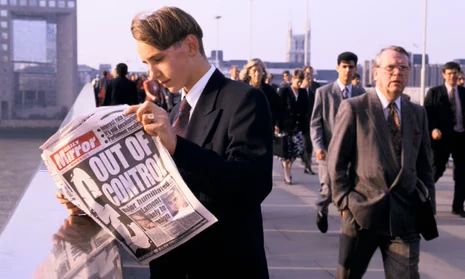
The next morning’s headlines screamed “Black Wednesday”; the government had lost control of its currency and credibility.
For John Major, it was a political disaster. For many ordinary people, it was confusing — the pound had crashed, but the economy soon began to heal.
Freed from the ERM, the pound floated lower, making exports cheaper and boosting competitiveness. Inflation eased and growth returned faster than expected.
Lamont later called it “the right decision” Economists would later come to agree. But the damage to the conservative party’s reputation stuck.
Black Wednesday became shorthand for government failure and fueled a growing scepticism toward European economic integration — the early spark of the Euroscepticism that would later shape Brexit.
Soro’s reputation – Legend and Lightning Rod
It’s safe to say that by the next morning, George Soros woke up as a household name.
Newspapers crowned him as “the man who broke the Bank of England”
He didn’t gloat — he simply said he’d seen the inevitable.
To some he was a financial genius exposing political denial.
To others he was the face of ruthless speculation, proof that a handful of hedge funds could shake nations.
The truth however sits somewhere in the middle.
Soros did not cause the collapse: he recognised that the system Britain was defending couldn’t hold.
That one trade became legend — a case study in universities, a myth in the tabloids, a weapon for his critics. Even today, conspiracy theorists twist it into something sinister. But all he really did was highlight an uncomfortable truth: markets move faster than governments and emotion can’t outvote arithmetic.
The Lesson That Won’t Go Away
Today, governments still think they can talk markets into obedience. That they can promise stability and make it so.
But as Black Wednesday showed, confidence quickly evaporates once people stop believing the story.
It’s a lesson that’s replayed ever since — during the Asian Financial Crisis of 1997, the Greek debt collapse in 2010, and even the British government’s own mini budget chaos in 2022. Each time leaders insist the fundamentals are sound. Each time traders test them and win.
You cannot bluff numbers.
Soros made his millions and moved on. The Bank of England was rebuilt. Britain recovered.
But the scar stayed — a reminder that even the oldest institutions can break under pressure from a single, well-timed truth.
Currencies fall, economies recover, but reputations rarely do. And on that one Wednesday in 1992, one man proved it to be true.